Why Christian Films Matter Now
I’ve been watching faith-based films since the VHS days. And let me be honest—most of them weren’t great. In fact, some were downright painful to sit through. The message might have been solid, even beautiful, but the delivery? Cheesy dialogue, stiff performances, and acting that made you wince. It’s no wonder people outside the Church dismissed Christian films as second-rate sermons with a camera.
But here’s the thing—I never gave up hope.
Because I believe that stories have power. And when those stories are rooted in the truth of the Gospel and told with excellence, they can change lives. I’ve always longed for a time when Christian films wouldn’t just be tolerated by the culture—but respected. Not because they compromise to fit in, but because they rise above with truth and skill.
Now, it feels like we’re at a turning point.
Hollywood hasn’t stopped preaching—it just preaches a different gospel. Progressive moralism. Emotional spirituality. Vague ideas about love and self-fulfillment. These messages are being smuggled into everything from superhero franchises to “faith-friendly” dramas. And many Christians are unknowingly eating it up, just happy to see the name of Jesus mentioned—regardless of whether He’s represented truthfully.
That’s why this conversation matters.
We’re entering a new era of Christian films—one where believers are finally stepping up to produce content that’s not only theologically faithful, but artistically excellent. But the danger is still very real: if we chase popularity over truth, if we sacrifice Scripture to go mainstream, we’ll end up with a prettier version of the same problem.
So the question is worth asking:
Can Christian films go mainstream without losing the Gospel? I believe they can. But only if we get this next part right.
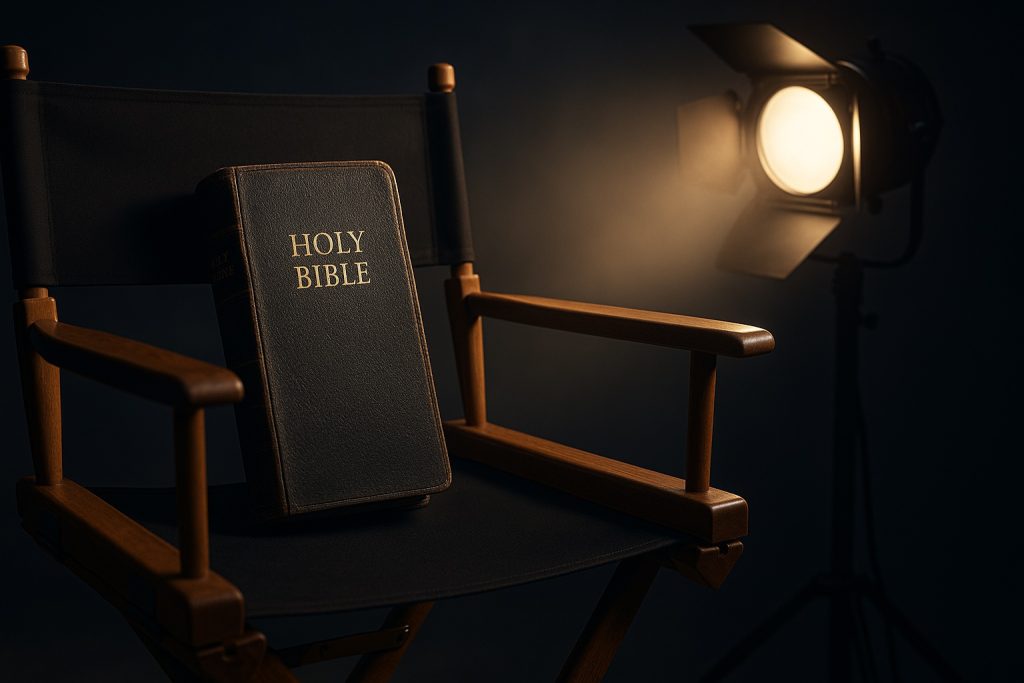
Hollywood Is Preaching, But It’s Not the Gospel
Let’s be clear—Hollywood has never been neutral. Every movie, every show, every carefully crafted story is preaching something. And lately, what it’s preaching sounds spiritual on the surface but is often the exact opposite of biblical truth.
We’re seeing an explosion of content that touches on faith, morality, redemption, even Jesus Himself. But more often than not, those themes are wrapped in a progressive, emotional gospel—one that prioritizes self over surrender, feelings over faith, and moral relativism over God’s unchanging Word.
Sometimes it’s blatant. Other times, it’s subtle.
You’ll hear lines like “follow your heart,” “love is love,” “your truth is enough.” It sounds harmless—even inspiring. But behind those messages is a worldview that contradicts Scripture at its core. It’s a form of spiritual deception that wears the costume of goodness, but leads people away from the Cross.
This is what I mean by the Hollywood agenda. It’s not just what’s shown—it’s what’s shaped. Entertainment is one of the most powerful tools of discipleship in our culture today, and for too long, Christians have underestimated its influence.
When we let our guard down and applaud anything with a vague mention of God or a moral lesson that “feels Christian,” we risk being discipled by the world instead of by the Word.
We have to start asking hard questions:
- Does this content align with Scripture, or just mimic its language?
- Is it leading people to the real Jesus—or a feel-good imitation?
- Are we being entertained into apathy?
Because if we’re not careful, we’ll find ourselves consuming sermons from Hollywood—sermons that sound holy but are built on sand.
The Chosen: When Popularity Sacrifices Scripture
I’ll admit it up front—The Chosen has done some remarkable things. It’s reached people who would never have picked up a Bible. It’s sparked conversations about Jesus across the world. And on a surface level, that sounds like a win.
But here’s where I have to be honest.
As much as I appreciate the reach and the storytelling skill, I believe The Chosen has crossed a line that Christians should be deeply concerned about: it takes serious liberties with Scripture. And when it comes to portraying the Son of God, accuracy isn’t optional—it’s essential.
Scenes are invented. Dialogue is added. Entire subplots are imagined. The character of Jesus, though compelling on screen, is often filtered through emotional human storytelling rather than reverent biblical fidelity. That’s a dangerous thing, especially when millions of viewers are watching the show as their primary encounter with Jesus.
I’ve heard the argument: “It’s just creative license.” But when your subject is the living Word of God, creativity has limits. The moment we start putting words in Jesus’ mouth that He never said—or giving Him emotional arcs that Scripture doesn’t describe—we risk shaping a version of Christ that people relate to more than they worship. A Jesus of sentiment, not of sovereignty.
That’s why I don’t see The Chosen as just another faith-based drama. I see it as a cautionary tale. A reminder that even the most well-meaning Christian media can subtly lead people away from truth if it compromises the authority of Scripture.
I’m not saying God can’t use it. I’m saying we should be wise enough to recognize when something popular doesn’t always mean something faithful.
Because if Christian films are going to go mainstream, they can’t do it by editing the Gospel to be more palatable. That might build a fanbase—but it won’t make disciples.
The Wonder Project: Excellence Without Compromise
Now this—this is what gives me hope.
When I first heard about The Wonder Project, I was cautiously optimistic. We’ve been promised “high-quality Christian films” before, only to be handed low-budget productions with wooden dialogue and painfully forced altar calls. But this feels different.
The Wonder Project isn’t just trying to make Christian content—it’s trying to do it with mainstream-level excellence and theological integrity. And from what I’ve seen so far, they’re on the right track.
Take their new series House of David, for example. It’s cinematic. It’s gripping. The production value rivals anything you’d see on a major streaming platform. But what really caught my attention? It doesn’t water down the Word. It doesn’t tiptoe around truth. It tells the story of David—the real one—with all the biblical weight it deserves.
And here’s the part that matters to me most: the acting is actually good.
Finally. We’re seeing performances that feel authentic, not like church skits stretched into feature films. It’s such a breath of fresh air. Because let’s be honest—if the acting isn’t believable, the message won’t be either. I’ve sat through too many well-intentioned movies that completely lost their impact because the characters just didn’t feel human.
But with The Wonder Project, I see a new standard emerging. One where we no longer have to choose between truth and talent—where we can have both. And that’s exactly what we need if we’re going to reach a world that’s used to Hollywood polish.
This is how Christian films can go mainstream without losing the Gospel: by raising the bar, not lowering the message.
If we want to engage the culture, we have to speak its language—but we don’t have to abandon our own. We can be excellent without being compromised. And The Wonder Project is proving that it’s possible.
Kingdom Story Company: Bridging Faith and Theaters
Another major player worth highlighting is Kingdom Story Company—the team behind films like I Can Only Imagine, I Still Believe, and Jesus Revolution. They’ve done something few others have: taken Christian stories and made them work on the big screen. Theaters. Wide release. Real box office numbers.
And I’ll say this—what they’ve done matters.
These films have introduced millions of people to testimonies of faith, redemption, and perseverance. They’ve told the real stories of real people who encountered Christ in life-changing ways. And they’ve done it with production quality that finally made the Christian film world feel, well…professional.
But here’s an important distinction:
Kingdom Story specializes in Christian biopics—inspiring accounts of believers, musicians, preachers, and movements. What they’re not doing (at least not yet) is telling the stories of Scripture itself. That’s not a criticism—it’s just a different lane.
And while testimonies are powerful, they’re not the Gospel in full. They point to it, yes. But they don’t replace it.
That’s why I see Kingdom Story as part of the solution—but not the whole picture. They’ve helped bridge the gap between the faith world and the film world, proving that Christian films can succeed in mainstream markets. But now we need to take that success and use it to bring the actual stories of the Bible—unfiltered and uncompromised—to the forefront.
We need the testimonies.
We need the artistry.
But most of all, we need the truth of Scripture to shine through.
Kingdom Story helped open the door. Now it’s time for more creators to walk through it with courage and conviction.
The Call: Christian Films Must Be Bold AND Biblical
This is the moment we’re in—and it’s critical. The culture is open to spiritual stories. People are hungry for meaning. Hollywood is experimenting with religious themes. The door is cracked open.
But if we’re not careful, we’ll walk through that door with all the wrong priorities.
We don’t need Christian films that merely inspire people. We need films that proclaim truth. We don’t need emotional morality tales dressed in vague spirituality. We need bold, biblical storytelling—the kind that doesn’t flinch at the hard parts of the Gospel.
That doesn’t mean every Christian film has to retell a Bible story or portray Jesus directly. Some of the most powerful movies I’ve ever seen were just honest, real-life dramas—a parent grieving the loss of a child, someone walking away from faith after heartbreak, or a man finding Christ in the middle of addiction. Those kinds of stories often move people even more than biblical epics, because they feel close to home. We need both. We need the stories that come straight from Scripture and the ones that meet people in today’s broken world and point them to the hope of Jesus. If the truth of the Gospel is at the center, there’s room for creative freedom—and incredible impact.
Yes, we want good production value.
Yes, we want excellent acting and strong scripts.
But none of that matters if the message is compromised.
The world doesn’t need a safer Jesus. It needs the real one.
That means filmmakers need to stop trying to sanitize Scripture for the sake of broader appeal. And it means viewers—Christians like you and me—need to stop giving a pass to anything that “feels Christian” but doesn’t hold up to the Bible.
The moment we start treating theology as optional in storytelling is the moment we stop telling Christian stories altogether.
Christian films must be bold enough to speak truth in a world of lies—and grounded enough to stand on the authority of God’s Word without wavering. That’s the only way this movement will have eternal impact, not just emotional resonance.
That’s also why we have to be discerning when we see progressive messages disguised as spiritual insight.
It’s time we raise the bar—not just in production, but in conviction.
Closing Charge: Discernment in an Entertainment-Driven World
We live in a culture where screens disciple more people than sermons. Entertainment shapes minds, softens hearts, and defines what people believe about truth, identity, and even God. That’s why this isn’t just about movies—it’s about the battle for influence.
And Christian films are right in the middle of it.
If we’re going to engage this world for Christ, we can’t afford to keep producing weak, watered-down stories that barely reflect the Bible. At the same time, we also can’t settle for poorly made projects just because they “have good intentions.” We need both truth and quality. We need films that are spiritually grounded and artistically excellent.
And most of all, we need discernment.
Just because something calls itself Christian doesn’t mean it’s faithful. Just because a show makes you feel something doesn’t mean it’s true. We have to weigh everything—everything—against the Word of God.
That means asking tough questions about what we consume.
- Does this film point me to Christ or just make me feel inspired?
- Is it rooted in Scripture or loosely based on spiritual themes?
- Am I more excited about the production than I am about the truth it claims to share?
We can no longer afford to be passive viewers. The stakes are too high.
I’m encouraged by what studios like The Wonder Project are doing—raising the bar, taking Scripture seriously, and finally proving that Christian films don’t have to be cheesy to be powerful. But we need more of it. A lot more.
The world is watching. And it’s preaching.
But so are we.
Let’s make sure our message isn’t just loud—it’s true.
Let’s tell stories that honor Christ, uphold His Word, and do it with excellence that reflects His glory.
Arch Kennedy
Bold, Unfiltered, and Unafraid
 Biblical Truth Shouldn’t Be Dangerous—But It Is
Amen . Well said and fully agreed
Thank you for sharing. It has given me some interesting points to ponder