Today, Christians and Halloween has become a topic that stirs debate in churches and families alike. Some believers avoid the day altogether, while others embrace it without much thought. But the real question isn’t whether pumpkins and candy are sinful. The real issue is where to draw the line between innocent fun and spiritual danger.
For many of us, October brings back memories of costumes, pumpkins, and chilly nights spent trick-or-treating. I remember dressing up as Frankenstein, running from house to house with friends, laughing, and yes—loving the thrill of being just a little scared. But I wasn’t celebrating evil. I was enjoying childhood fun.
Christians and Halloween can coexist in ways that honor God—but not when occult practices or darkness are embraced.
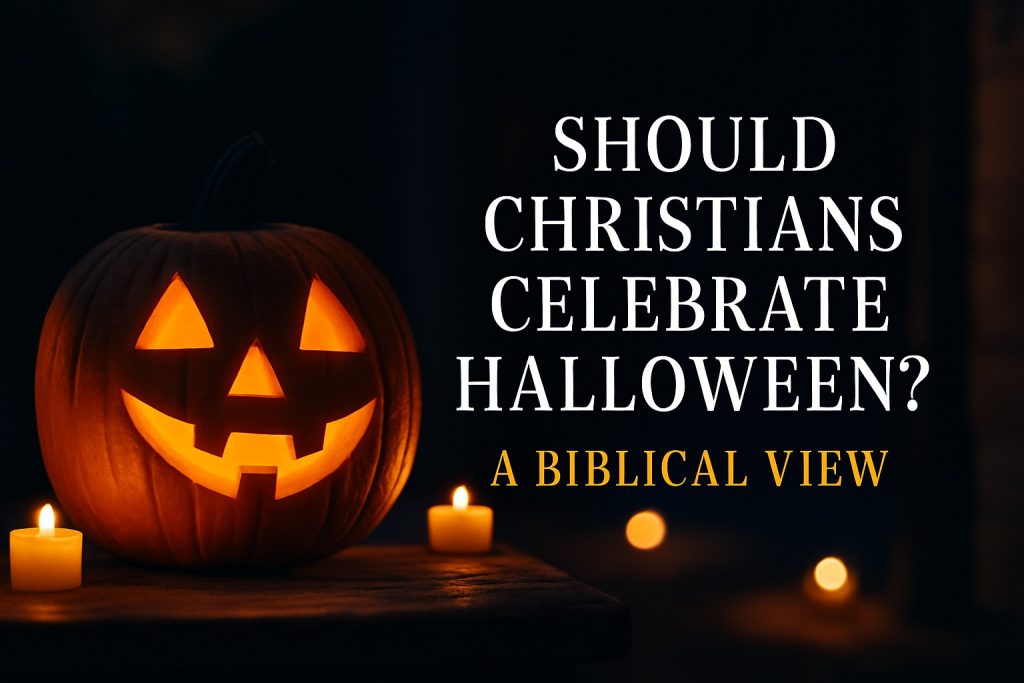
Christians and Halloween — The Pagan Origins and Why That Alone Doesn’t Decide the Issue
Many Christians object to Halloween entirely because of its pagan roots — and it’s true, the holiday didn’t begin as a Christian celebration. It traces back to Samhain, an ancient Celtic festival marking the end of harvest and the beginning of winter. The Celts believed that on the night of October 31, the boundary between the living and the dead blurred and that spirits could roam the earth.
Centuries later, the Church established All Saints’ Day and All Souls’ Day to redirect the pagan festival toward Christian observance. That’s where the name “All Hallows’ Eve” — eventually “Halloween” — comes from.
Pumpkin carving also has old pagan roots. In Ireland, people carved faces into turnips to ward off spirits. When the tradition came to America, pumpkins replaced turnips simply because they were larger and easier to carve.
So yes — Halloween has pagan beginnings. But here’s what many believers don’t consider: pagan origin doesn’t automatically mean present participation is sinful.
Paul addressed this kind of issue directly in 1 Corinthians 8, when some Christians worried about eating meat sacrificed to idols. His response was clear:
“We know that an idol is nothing at all in the world and that there is no God but one.”
In other words, if you’re not participating in idol worship, the meat itself is just meat. Likewise, carving a pumpkin or handing out candy isn’t worshiping pagan gods — it’s cultural tradition.
The deciding factor is what you’re aligning with spiritually.
— If it glorifies darkness, it’s off-limits.
— If it’s neutral, it can be redeemed and used for good.
Light doesn’t need to hide from darkness — it exposes it. Ephesians 5:11 says, “Have nothing to do with the fruitless deeds of darkness, but rather expose them.”
This means Christians have two biblically sound options:
— Reject Halloween entirely if their conscience or conviction leads them to.
— Redeem it by participating in ways that glorify Christ and reject the occult.
Both positions can honor God — as long as they are rooted in truth, not fear or cultural tradition.
A Culture That Blurs the Lines
Over time, Halloween has shifted from a night of costumes and candy into a cultural celebration that glamorizes the occult. You can find tarot cards, Ouija boards, and spell kits at mainstream retailers. TV shows and social media make witchcraft, demons, and spiritualism look “fun” or “empowering.”
An ex-psychic recently warned that these tools of divination are being marketed especially around Halloween, and what seems innocent “ended up to be an addictive, horrible rabbit hole of destruction.”
Read the story at CBN.
What’s packaged as seasonal entertainment often normalizes spiritual darkness, desensitizing both kids and adults to practices God has clearly forbidden.
I’ve written before about how cultural relativism blinds people to spiritual truth. Read my post “Biblical Truth vs. Cultural Relativism.”
This isn’t just a holiday issue. It’s a spiritual discernment issue.
What God’s Word Says About the Occult
The Bible doesn’t mention Halloween directly, but it speaks with absolute clarity about the reality of witchcraft, divination, and demonic powers:
— Deuteronomy 18:10–12 — “There shall not be found among you anyone… who practices divination, tells fortunes, interprets omens, or is a medium or a necromancer… For whoever does these things is an abomination to the Lord.”
— Leviticus 19:31 — “Do not turn to mediums or seek out spiritists, for you will be defiled by them. I am the Lord your God.”
— Galatians 5:19–21 — Witchcraft is listed among the acts of the flesh that separate people from the kingdom of God.
— Ephesians 6:12 — “For we do not wrestle against flesh and blood, but against the rulers, against the authorities, against the cosmic powers over this present darkness, against the spiritual forces of evil in the heavenly places.”
One ministry resource explains: “Because of its decidedly pagan origins… the answer to whether Christians should celebrate Halloween is a resounding no. The answer to whether Christians can participate in Halloween activities without compromising their faith is more difficult.”
Read more at GotQuestions.
These warnings aren’t metaphorical. God isn’t using poetic language. He’s describing real spiritual powers and commanding His people to stay away from them.
What Halloween Is (and Is Not)
Here’s the key: Halloween itself is not inherently sinful. It’s a date on a calendar—a cultural event. The heart posture and participation are what matter.
— Romans 14:14 — “I know and am persuaded in the Lord Jesus that nothing is unclean in itself, but it is unclean for anyone who thinks it unclean.”
— 1 Corinthians 10:31 — “So whether you eat or drink or whatever you do, do it all for the glory of God.”
Carving pumpkins, wearing a neutral costume, or collecting candy isn’t sin. But participating in anything that glorifies the occult, celebrates death, or mocks God’s truth crosses a line.
Witch Costumes Aren’t “Just Cute”
I’ll be honest — this is where God really opened my eyes. I grew up surrounded by witch costumes. They were everywhere. Every Halloween, little girls wore pointy hats, black dresses, and broomsticks. It never once felt dark or dangerous to me. It was just… normal.
But biblically, witchcraft isn’t a cartoon or a game. Witchcraft is real and something God clearly condemns.
— Deuteronomy 18:10–12
— Exodus 22:18 — “You shall not permit a sorceress to live.”
— Galatians 5:19–21
Witchcraft represents a spiritual power opposed to God. And over time, our culture has taken something spiritually serious and turned it into something sparkly and cute. That’s exactly how deception works. Make darkness look harmless, and no one questions it.
When kids dress as witches, they’re not doing something intentionally evil. But the symbol itself represents something real — and it subtly normalizes what God calls darkness.
My Personal Wake-Up Call
When this truth really hit me, I was stunned. It honestly felt like something from my childhood had been flipped upside down.
I’ve always associated Halloween with happy, innocent memories — not evil. I never once thought twice about a little girl wearing a witch hat. It was as normal to me as carving a pumpkin. But realizing what that costume actually represents biblically… it was a shock.
I felt grief. Real grief. Because something I had always viewed through nostalgia was something God views through holiness. It’s sobering when the light of God’s Word exposes something you’ve accepted without question your entire life.
But that’s the beauty of walking with Jesus — He doesn’t reveal truth to shame us. He reveals it to set us free from cultural blindness.
Ephesians 5:8 says, “For you were once darkness, but now you are light in the Lord. Walk as children of light.”
Demon Costumes and Spiritual Reality
Witchcraft isn’t the only costume issue. Demons are another.
The Bible never describes what demons look like, because they are spiritual beings, not flesh-and-blood monsters. But what Scripture does tell us is that demons are real, and they are enemies of God (Ephesians 6:12).
Those little red Halloween demons with horns and tails? That’s pop culture — not Scripture. But even though the costume isn’t “accurate,” it symbolizes something real and evil. And that matters.
Dressing up as Frankenstein is not the same as dressing as a demon. Frankenstein is a fictional character. A demon is a spiritual reality. Wearing something that represents a real spiritual enemy trivializes what Scripture treats seriously.
Ephesians 5:11 says, “Have nothing to do with the fruitless deeds of darkness, but rather expose them.”
Discernment, Not Legalism
Some believers avoid Halloween completely. Others participate carefully — pumpkins, costumes, candy, and community fun — without aligning with anything spiritual or dark. Both can be valid, as long as the boundary lines are rooted in Scripture.
This isn’t about being legalistic or fearful. It’s about walking in wisdom.
Jesus said we are to be “in the world but not of it” (John 17:15–16). That means we can participate in culture without compromising with darkness.
Where Christians Must Draw the Line
As believers, we should draw a firm spiritual line:
— No glorifying or trivializing the occult (witches, demons, Satan).
— No celebrating darkness or death.
— No spiritual compromise dressed up as fun.
— Yes to family, community, and joy — as long as it honors God.
1 Thessalonians 5:22 — “Abstain from every form of evil.”
Romans 12:2 — “Do not be conformed to this world, but be transformed by the renewing of your mind.”
How Christians Can Shine Light on Halloween
Halloween can also be an opportunity for outreach — if approached wisely.
— Host a Christ-centered fall event or alternative celebration.
— Hand out candy with Scripture or church invites.
— Model kindness and warmth to neighbors.
— Teach kids early about the difference between pretend and spiritual reality.
You can read more about how Christians can stand firm in a secular culture here: The Role of Faith in an Increasingly Secular Society.
We are not called to retreat in fear. We’re called to stand in truth with love.
The Freedom of Conviction
Romans 14:5 says, “One person considers one day more sacred than another; another considers every day alike. Each of them should be fully convinced in their own mind.”
God allows room for personal conviction on how to approach days like Halloween. But He does not allow compromise with what He has clearly called evil.
Some may choose to avoid it entirely. Others may enjoy neutral traditions with discernment. The important thing is this: align your choices with Scripture, not culture.
Final Biblical Takeaway
Halloween itself isn’t the enemy. The enemy is the darkness masquerading as fun. Christians don’t need to fear costumes or candy — but we must never compromise with what God calls evil.
Our role is to discern, not conform. To let the light of Christ shape how we see cultural traditions, even the ones we’ve cherished since childhood.
For me, this was a wake-up call. God gently peeled back layers of nostalgia I didn’t even know were there. And once you see something through His Word, you can’t unsee it.
Arch Kennedy
Bold, Unfiltered, and Unafraid
 Bible Sales Surge After Charlie Kirk’s Assassination — Is It Revival?
Leave a Reply