Free Speech in Media has been functionally absent from American talk shows for years, not because of accidental imbalance, but because leftist ideology has come to dominate those platforms almost entirely. Late night shows and daytime talk shows no longer represent a range of political thought. They overwhelmingly reflect progressive viewpoints, while conservative voices are routinely excluded, dismissed, or caricatured. That reality has been obvious for a long time. What makes the recent FCC action so significant is that it finally acknowledges this imbalance and challenges the assumption that talk shows can operate as political platforms without any obligation to fairness.
This matters because talk shows are no longer marginal entertainment. They are cultural power centers. Millions of Americans consume political messaging primarily through these programs, often without watching traditional news at all. When those shows present only one side of the political spectrum, the public is not hearing a debate. They are being trained to see one worldview as normal and the other as unacceptable.
Featured Snippet Takeaway
Free Speech in Media requires that opposing viewpoints remain accessible to the public. When talk shows become dominated by leftist ideology and systematically exclude conservatives, they shape culture without accountability. The FCC’s recent move represents a rare challenge to that one sided dominance and a reminder that a free society depends on open discourse.
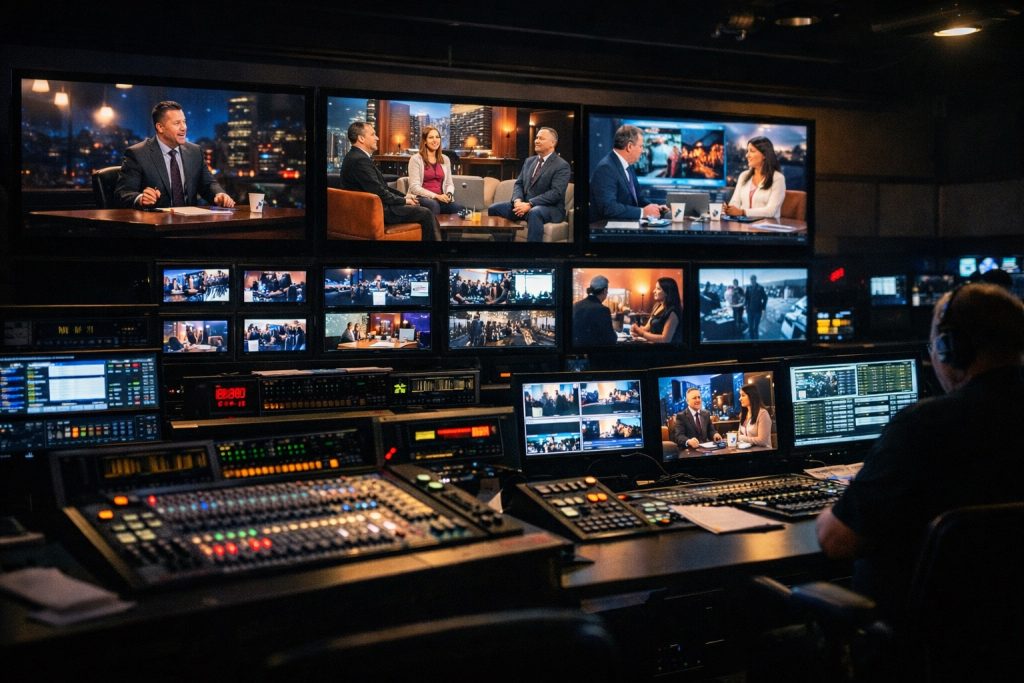
How talk shows became political gatekeepers
There was a time when talk shows were clearly defined as entertainment. Political humor existed, but it was not the organizing principle of the program. That distinction no longer holds. Many modern talk shows now devote significant portions of their airtime to political commentary, ideological framing, and moral judgments that consistently align with progressive activism.
Daytime talk shows reach especially large audiences. Programs like The View are watched by millions every day, including viewers who do not engage with politics anywhere else. When such a platform repeatedly advances leftist narratives while excluding conservative guests, it does more than express opinion. It establishes boundaries around what is considered reasonable, compassionate, or even acceptable.
Late night shows operate in a similar way. Hosts deliver monologues that function as political messaging rather than satire. Guests are selected to reinforce ideological consensus rather than challenge it. Conservatives, when mentioned at all, are often portrayed as objects of ridicule rather than participants in legitimate debate.
The result is a media environment where one political worldview is amplified and normalized, while another is effectively erased.
Why conservative exclusion matters in a free society
This is not about demanding equal applause or cultural approval. It is about access. In a free society, citizens must be able to hear competing arguments and evaluate them honestly. When conservatives are absent from major cultural platforms, their ideas are not debated. They are replaced with strawmen.
That substitution has consequences. When people never hear conservative reasoning directly, they begin to associate conservatism itself with moral failure. Positions are no longer understood as differences in principle, but as evidence of malice or ignorance. Over time, this reshapes public perception in ways that no election alone can correct.
A free society cannot function when one side of the political spectrum controls cultural narratives while presenting itself as neutral entertainment. That is not pluralism. It is ideological insulation.
The FCC’s action and why it is different
The importance of the FCC’s recent move is not that it immediately fixes the problem. It is that it challenges a long standing loophole. For years, talk shows have claimed exemption from equal treatment requirements by labeling themselves as entertainment, even while functioning as political broadcasters.
The FCC is now signaling that this assumption may no longer hold. If a program consistently engages in political content, hosts political guests, and advances political viewpoints, it may no longer qualify for special treatment simply because it uses humor or casual conversation. As reported by Fox News, the FCC is questioning whether shows like late night programs and daytime talk shows that regularly feature partisan commentary should continue to receive automatic exemptions from equal time expectations (Fox News coverage of the FCC action).
This is not censorship. It does not silence anyone. It simply recognizes that influence carries responsibility. If a show chooses to shape political opinion, it cannot simultaneously claim immunity from the standards that govern political discourse.
That recognition alone marks a meaningful shift.
When cultural dominance replaces debate
One of the most dangerous developments in modern media is replacement. Talk shows have replaced news for many viewers. Opinion has replaced reporting. Emotion has replaced analysis.
When politics is delivered through entertainment, audiences lower their defenses. They are not listening critically. They are absorbing tone, attitude, and moral framing. Over time, this creates a cultural consensus that feels organic but is carefully curated.
When that curation excludes conservatives almost entirely, the public loses its ability to distinguish disagreement from immorality. Dissent becomes suspect. Opposition becomes offensive.
That is how free speech erodes without laws being passed.
Why Christians should be paying close attention
As a Christian, I care about this issue not simply because it affects conservatives, but because of what follows when one ideology dominates culture unchecked. Progressive ideology increasingly treats Christianity itself as a moral problem. Biblical teaching is described as harmful. Traditional Christian convictions are labeled hateful. Faith is not debated. It is pathologized.
This framing does not emerge in a vacuum. It is reinforced by media environments where only one moral framework is presented as compassionate or enlightened. When Christians are never allowed to articulate their beliefs on major platforms, those beliefs are defined for them by their critics. I have written previously about this growing pressure on believers in my post on how Christians should respond to cancel culture.
That is why free speech matters so deeply to people of faith. The gospel has always existed in hostile cultures, but it has never flourished where speech is restricted to one worldview. Once a belief system is labeled as dangerous, silencing it begins to feel virtuous.
The pattern Scripture warns us about
Scripture is clear that truth will be opposed, not merely debated. When light confronts darkness, the response is often anger rather than argument. The Bible prepares Christians for cultural resistance, but it does not tell us to ignore the structures that produce it.
When media systems consistently portray Christianity as a threat, they shape public conscience in ways that justify exclusion. Marginalization precedes suppression. Mockery precedes censorship. Cultural consensus precedes coercion. This is not hypothetical, as I discussed when examining how biblical teaching is already being treated as dangerous speech in parts of the West in my article on biblical hate speech and Europe’s warning to the U.S..
Why this moment should not be ignored
The FCC’s action may face legal challenges. It may be limited in scope. It may not immediately change programming. But it matters because it acknowledges something many Americans already know. Talk shows are not neutral. They are ideological.
By questioning automatic exemptions, the FCC is challenging the idea that political influence can hide behind entertainment indefinitely. That challenge creates space for conversation, scrutiny, and accountability.
In a society that claims to value freedom, that space matters.
What fair media actually requires
Fairness does not require equal outcomes. It requires openness. It requires allowing opposing viewpoints to be heard without distortion. It requires resisting the urge to define disagreement as harm.
If talk shows want to advocate politically, they are free to do so. But they should be honest about what they are doing, and they should not expect exemption from standards designed to protect public discourse.
A culture that hears only one side is not informed. It is managed.
The larger danger ahead
When leftist ideology dominates media, it does more than influence elections. It shapes morality. It defines virtue. It redraws the boundaries of acceptable belief. Christians should care about this not because they seek power, but because truth must remain speakable.
Free Speech in Media is not an abstract ideal. It is the condition that allows conscience to function in public. Without it, society drifts toward uniformity enforced by shame, exclusion, and eventually law.
That is why this moment matters. Not because it favors one party, but because it challenges a culture that has grown comfortable silencing dissent.
Arch Kennedy
Bold, Unfiltered, and Unafraid
Watch my full commentary below:
 How Zionism and Christian Zionism Get Twisted
Leave a Reply