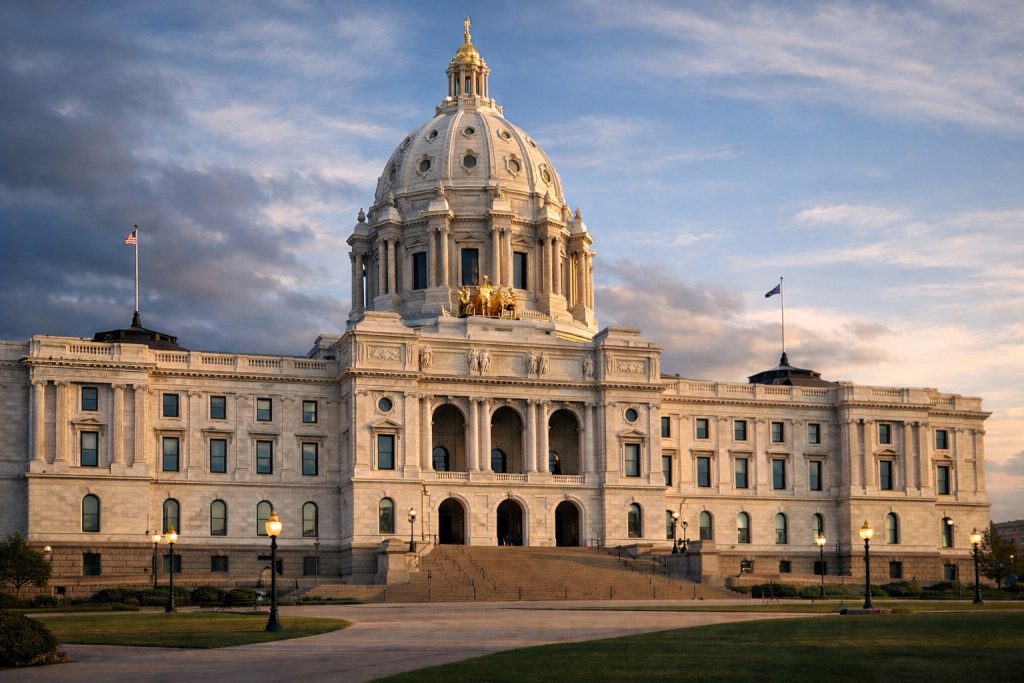
The recent controversy surrounding a Satanic plaque displayed in the Minnesota State Capitol wasn’t just another culture-war headline. For me, it raised a deeper question about leadership, faith, and moral responsibility in public life. When the governor of a state responds to something like this by appealing almost exclusively to process and free speech, it tells us something important about how he thinks, how he governs, and how faith functions in his worldview.
I’m not interested in outrage, speculation, or judging anyone’s heart. I am interested in patterns, fruit, and what moments like this reveal.
Featured Snippet Takeaway
Tim Walz faith appears to function primarily as a personal or social value rather than a governing authority, and that distinction helps explain why moral neutrality is elevated over moral clarity in moments of cultural conflict.
The plaque itself was provocative by design. It thanked Governor Tim Walz for “not standing in the way of spreading Satanism” and mocked Christian belief. Predictably, it sparked public backlash, as reported by CBN News’ coverage of the Satanic plaque in the Minnesota State Capitol. The response from the governor’s office was that he disagreed with the message but would not intervene, citing First Amendment protections and the principle that he does not police speech inside the Capitol.
That explanation matters. Legally, it may be defensible. Spiritually and culturally, it reveals something deeper.
The Difference Between Legal Permission and Moral Leadership
The First Amendment limits what government may prohibit. It does not eliminate a leader’s responsibility to speak clearly about right and wrong. A governor can uphold constitutional protections while still making moral distinctions. Saying “this is legally allowed” is not the same thing as saying “this is good, wise, or worthy of public honor.”
In this case, the response stopped at legality.
That matters because leadership is never neutral. When a leader consistently refuses to distinguish between truth and error in the public square, neutrality itself becomes a moral posture. Scripture does not treat neutrality as virtuous. It treats discernment as essential.
What This Reveals About Tim Walz Faith
When Governor Walz has spoken about his faith publicly, it has almost always been framed in social terms. Caring for others. Treating people kindly. Supporting inclusion. Those are not bad things. They are biblical values. But they are not the whole of biblical faith.
Christianity does not reduce faith to social outcomes. It centers faith on obedience to God, submission to His authority, repentance, and transformation. Love and obedience are not competitors in Scripture. Jesus explicitly ties them together.
Progressive Christianity tends to separate what Scripture holds together. Love becomes affirmation. Inclusion becomes the highest good. Obedience becomes optional, contextual, or quietly sidelined. Faith is affirmed as long as it does not impose moral clarity. I’ve written more extensively on this pattern in The Real Danger of Progressive Christianity.
When a leader’s faith functions primarily in that framework, moral neutrality in governance is not surprising. It is consistent.
Leadership Detached From Scripture Produces Drift
This is not about one plaque. It is about a broader pattern that many people in Minnesota are feeling. Confusion. Disorder. Cultural friction. A sense that lines are no longer clear.
Scripture teaches that authority is meant to restrain evil and promote good. When leadership becomes unwilling to define either, chaos follows. Not immediately, and not always dramatically, but steadily.
That doesn’t mean every problem in a state can be laid at one person’s feet. It does mean worldview matters. Theology matters. The way leaders understand truth, authority, and morality shapes policy, culture, and public tone.
The Church’s Role in This Moment
This story also forces Christians to examine our own blind spots. Some churches have emphasized obedience without love and caused real harm. That matters. But culturally, that is not the dominant danger today.
The greater danger is a version of Christianity that talks endlessly about love while quietly abandoning obedience. A faith that wants the moral credibility of Christianity without the authority of Scripture. A faith that blesses neutrality rather than truth.
When that version of Christianity influences leadership, moments like this are not anomalies. They are revelations.
Discernment, Not Condemnation
This is not about condemning Tim Walz as a person. I’m not doing that, and I don’t believe Christians are called to do that. This is about discernment. Jesus told us to look at fruit. Paul told us to test everything.
Looking at how a leader responds to moments of moral conflict tells us something about what they believe, what they fear, and what they are willing to defend.
In this case, the fruit points to a leadership philosophy shaped more by procedural neutrality than by moral conviction rooted in Scripture.
That should sober Christians, not enrage them. It should push us toward prayer, clarity, and a deeper commitment to biblical truth, not reactionary politics.
Because when faith is reduced to social language alone, it may still sound compassionate, but it loses its power to order, correct, and heal a culture that desperately needs more than neutrality.
Arch Kennedy
Bold, Unfiltered, and Unafraid
Watch my full commentary below:
 When God Is Silent and Faith Feels Exhausting
Leave a Reply